THUS SPOKE MY OLD MAN !
Welcome to the Idle Words Said in Passing!
Philosophy
of
MARCUS AURELIUS ANTONINUS
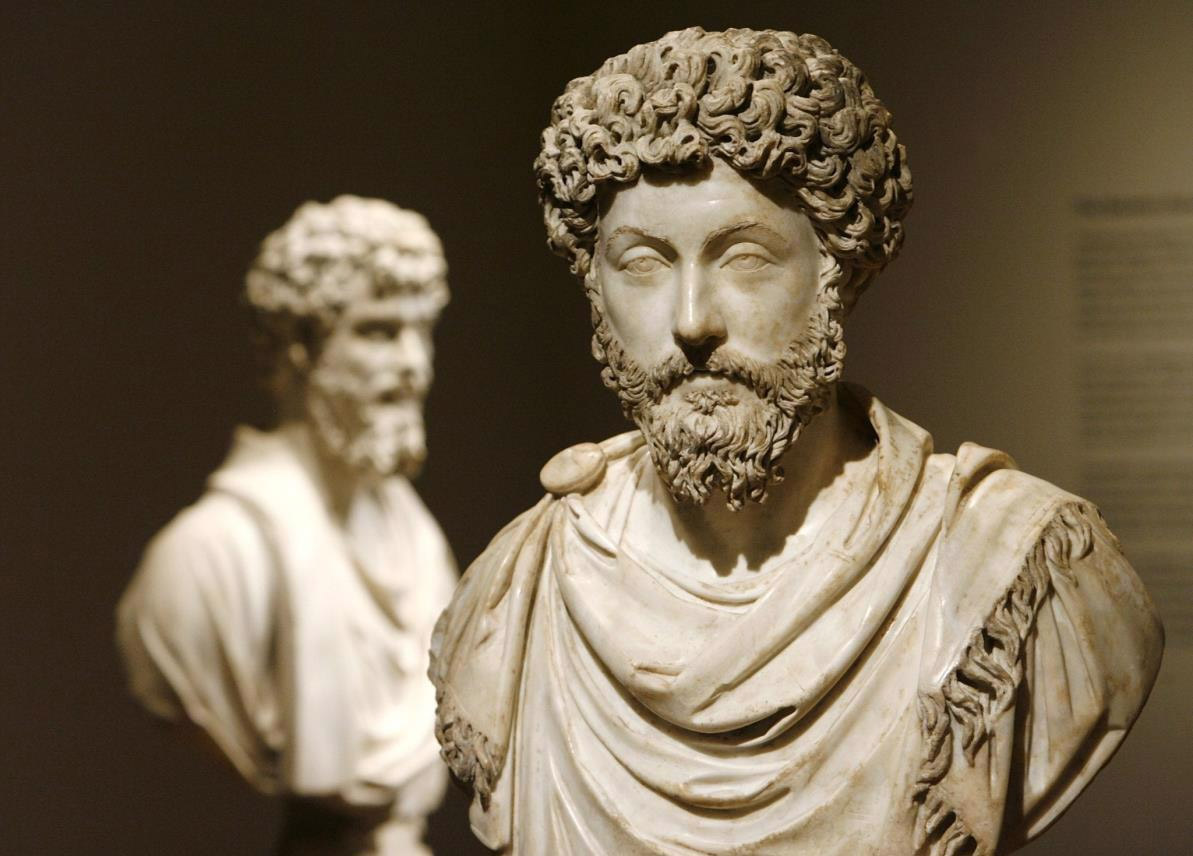
The principles of Stoic philosophy transferred from Greece to Rome has have through a marked and significant evolution, finding resonance and practical application within the Roman ethos. The doctrines of Zeno and his successors found a natural affinity with the solemnity and pragmatic sensibility of the Romans. Even in the Republican era, figures like M. Cato Uticensis exemplified Stoic virtues, were living and dying in accordance with their professed beliefs, as noted by Cicero. Amidst the tumultuous periods following Augustus's death up to Domitian's reign and murder, Stoicism provided solace and guidance for adherents of the traditional faith amidst imperial oppression, almost universal corruption and significant moral decay. Remarkable individuals like Paetus Thrasae, Helvidius Priscus, Cornutus, and G. Musonius Rufus stood firm, propelled by a steadfast conscience and a lofty conception of human purpose. Poets such as Persius and Juvenal, with their strong language, robust expressions and stoic ideals, imparted timeless wisdom, wisdom that survived and is still relevant today. Persius died during Nero's brutal rule, Juvenal survived tyrannical regime of Domitian to live and witness eras of renewal under Nerva, Trajan, and Hadrian.
Epictetus, a Phrygian Greek, and Marcus Antoninus, a Roman emperor, emerged as prominent exponents of later Stoic philosophy. Epictetus, once a slave in Rome, likely encountered Stoic teachings under G. Musonius Rufus before his manumission and subsequent exile by Domitian's decree. Retreating to Nicopolis (Epirus), he imparted his wisdom to his disciples. Like other great philosophy teachers, Epictetus left no written record of his work. It was his pupil Arrian who preserved Epictetus' teachings in the Discourses and Enchiridion.
Arrian wrote eight books of the Discourses of Epictetus, of which only four are extant together with some fragments. Also, we still have from Arrian's hand small Enchiridion or Manual of the main precepts of Epictetus preserved by Simplicius. This is a valuable commentary on the Enchiridion by Simplicius, who lived in the time of the emperor Justinian. (see Box D2)
Antoninus, in his gratitude towards (Book 1,7) his mentors, notably Junius Rusticus, acknowledged his debt to Epictetus, whose doctrines deeply influenced his own reflections (see Book 4, 41; Book 11. 34, 36). While their philosophical tenets aligned, Epictetus favoured a conversational style, whereas Antoninus wrote introspective musings, resulting in distinct methods of expression using unconnected paragraphs and segments which are often obscure and difficult to translate.
----------------------------------------
Explanatory Box D2
Trajan, Caesar Nerva Traianus Divi Nervae Filius Augustus, 53 - 117CE) was Roman emperor from 98 to 117CE. Officially declared by the Senate Optimus Princeps ("best ruler"), Trajan was a successful soldier-emperor who presided over the military expansion in Roman history. He is also known for his philanthropic rule. Hadrian, Publius Aelius Hadrianus Augustus; 76 -138 CE) was Roman emperor from 117 to 138.CE His father was of senatorial rank and was a first cousin of Emperor Trajan. Arrian of Nicomedia (Lucius Flavius Arrianus; c.?86/89 - c.? 146/160 CE) was a Greek historian, military commander and philosopher of the Roman era. Arrian was a pupil of Epictetus around 108 CE. He published "Discourses of Epictetus. According to George Long, Arrian noted from Epictetus' lectures for his private use, however, sometime later he composed the Discourses. Photius states that Arrian produced two books the Dissertations and the Discourses. The Discourses are also known as Diatribai and are thought to be a verbatim recording of Epictetus' lectures. The Enchiridion is a short compendium of all Epictetus' philosophical principles. It is also known as a handbook, and A Mehl considers the Enchiridion to have been a vade mecum for Arrian. The Enchiridion is apparently a summary of the Discourses.
(1) Marcus Porcius Cato Uticensis, (95 BCE - 46 BCE), known as Cato the Younger (Cato Minor), was a Roman senator in the period of the late republic. An orator and a follower of the Stoic philosophy, in his lengthy conflict with Julius Caesar known for his moral integrity.
(2) Marcus Tullius Cicero (106 BCE - 43 BCE) was a Roman statesman, lawyer and philosopher. He was an important figure in the politics of the late Republic. His writings include treatises on rhetoric, philosophy and politics, he is one of Rome's greatest orators.
(3) Domitian (Titus Flavius Domitianus, c. 51 - 96 CE) was a Roman emperor who reigned from 81 until his death in 96CE.
(4) Publius Clodius Thrasea Paetus (died 66 CE), Roman senator. Known for his principled opposition to the emperor Nero and for his interest in Stoicism.
-- Helvidius Priscus, Stoic philosopher and statesman, lived during the reigns of Nero, Galba, Otho, Vitellius and Vespasian.
-- Gaius Musonius Rufus was a Roman Stoic philosopher, 1st century CE. He taught philosophy in Rome during the reign of Nero and so was sent into exile in 65 CE, returning to Rome only under emperor Galba. A collection of extracts from his lectures are still extant.
-- Aulus Persius Flaccus (34 - 62 CE) was a Roman poet and satirist of Etruscan origin. Decimus Junius Juvenalis, known in English as Juvenal, first and early second century CE.
----------------------------------------
Antoninus, in his gratitude towards (Book 1,7) his mentors, notably Junius Rusticus, acknowledged his debt to Epictetus, whose doctrines deeply influenced his own reflections (see Book 4, 41; Book 11. 34, 36). While their philosophical tenets aligned, Epictetus favoured a conversational style, whereas Antoninus wrote introspective musings, resulting in distinct methods of expression using unconnected paragraphs and segments which are often obscure and difficult to translate.
The Stoics categorized philosophy into three main branches: Physics (dealing with the natural world), Ethics (concerned with moral principles), and Logic (focused on reasoning and argumentation). (Book 8,13) Zeno of Citium (see Box D3) and Chrysippus originally made this division, although they arranged it as Logic, Physics, and Ethics. However, this framework predates Zeno, as was acknowledged by Plato according to Cicero.
Cleanthes (see Box D3), another Stoic thinker, expanded these divisions into six: Dialectic and Rhetoric (under Logic), Ethics and Politic, and Physics and Theology. While this subdivision served only practical purposes, it was emphasized that the unity of Philosophy as a whole is important. In the early Stoic tradition, Logic, or Dialectic, served as a tool rather than a central focus, aiding the exploration of other philosophical domains.
----------------------------------------
Explanatory Box D3
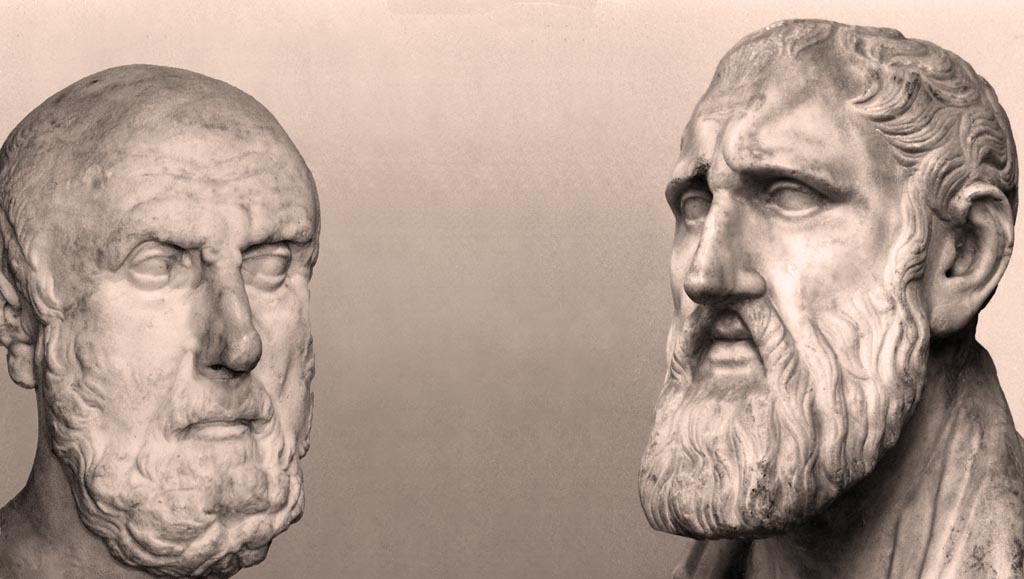
Zeno of Citium (circa 334 - circa 262 BCE) hailed from Phoenician descent in Citium, Cyprus, and emerged as a pivotal Hellenistic philosopher. Establishing the Stoic school circa 300 BCE in Athens, he drew inspiration from the moral principles of the Cynics. Stoicism, under Zeno's guidance, emphasized the pursuit of virtue and inner tranquillity through alignment with nature. This philosophy thrived as a prominent philosophical school from the Hellenistic era to the Roman period.
Cleanthes (circa 330 - circa 230 BCE), born in Assos, transitioned from a career in boxing to philosophy upon arriving in Athens. Immersing himself in Zeno's teachings. Following Zeno's passing, Cleanthes assumed leadership of the Stoic school (becoming a School's second head scholarch), diligently preserving and expanding upon Zeno's doctrines for 32 years. He introduced new concepts in Stoic physics, rooted in materialism and pantheism, and his notable work includes a Hymn to Zeus. Among his pupils, Chrysippus emerged as a significant figure in Stoicism.
Chrysippus of Soli (circa 279 - circa 206 BCE), a Stoic philosopher native to Soli, Cilicia, continued the legacy of Stoicism after becoming Cleanthes' pupil in Athens. Succeeding Cleanthes as the head of the school (notably, the third scholarch) a round 230 BCE, Chrysippus earned the moniker of the Second Founder of Stoicism for his profound contributions. His advancements spanned logic, epistemology, ethics, and physics, including the development of a pioneering system of propositional logic. Chrysippus played a pivotal role in propelling Stoicism to become one of the most influential philosophical movements across the Greek and Roman civilizations for centuries.
----------------------------------------
Cleanthes expanded his philosophical framework by intertwining Ethics and Politics, delving into both moral principles and the structure of civil society. His subdivision of Ethics into two distinct parts-Ethics in its narrower sense and Politics - acknowledged their interconnection while recognizing their separate domains.
While Marcus Antoninus focuses solely on Ethics, applying it practically to his personal and gubernatorial conduct, he grounds his ethical principles in reflections on Human nature, Universal Nature, and the relationship between individuals and the Cosmos.
This ethical foundation remains inseparable from considerations of Physics (the nature of things) and Theology (the nature of the divine). Antoninus emphasizes the importance of scrutinizing mental impressions and forming sound judgments, incorporating elements of Dialectic, albeit without offering a detailed exposition. He says (Book 8, 13), "Constantly and, if it be possible, on the occasion of every impression on the soul [See Box D4], apply to it the principles of Physic, of Ethic, and of Dialectic." He advises thorough examination of impressions, urging individuals to define and understand the essence of objects presented to them a process that inherently involves dialectical reasoning. In another section (Book 3, 11) he says, "To the aids which have been mentioned, let this one still be added: make for thyself a definition or description of the object (Greek: to phantaston) which is presented to thee, so as to see distinctly what kind of a thing it is in its substance, in its nudity, in its complete entirety, and tell thyself its proper name, and the names of the things of which it has been compounded, and into which it will be resolved." Thus, Antoninus utilizes Dialectic as a tool to reinforce his philosophical principles in Physics, Theology, and Ethics.
----------------------------------------
Explanatory Box D4
Ethic - [Greek: phantasia], Difficulty in Translation. George Long explains that the original is [Greek: epi pases phantasias]. We have no word which expresses [Greek: phantasia], for it is not only the sensuous appearance which comes from an external object, which object is called [Greek: to phantaston], but it is also the thought or feeling or opinion which is produced even when there is no corresponding external object before us. Accordingly, everything which moves the soul is [Greek: phantaston] and produces a [Greek: phantasia]. In this extract Antoninus says [Greek: physiologein, pathologein, dialektikeuesthai]. George Long has translated [Greek: pathologein] by using the word Moral (Ethic), and that is the meaning here.
----------------------------------------
There are various discussions regarding the Physical, Theological, and Ethical tenets found in the works of Antoninus, some of which new and some not accessible to all. Ritter, in his "History of Philosophy," briefly touches upon Antoninus' doctrines after elucidating those of Epictetus, though he suggests a more thorough treatment is available elsewhere. Another resource is J.M. Schultz's essay on the Philosophical Principles of M. Aurelius Antoninus, appended to his German translation of Antoninus (Schleswig, 1799).
With the aid of these helpful essays, other available translation and, of course, diligent personal study, one can grasp a sufficient understanding of Antoninus' principles. However, conveying these principles to others proves challenging due to the lack of organization in the original text, the disjointedness among paragraphs, textual corruptions, language obscurity, stylistic nuances, and occasional apparent contradictions in Antoninus' thoughts. It seems at times as if his principles are unsettled, and, maybe, clouded by doubt.
A person leading a tranquil life of contemplation, insulated from worldly affairs, may maintain mental equilibrium and philosophical consistency. Yet, such a person has not truly been tested. Their ethical philosophy and passive virtue might prove hollow when confronted with the harsh realities of existence. Fine moral thoughts and dissertations from individuals who have not experienced toil and adversity may be read, but they often fade into oblivion. A religion or ethical philosophy lacks substance unless the teacher has lived a life akin to an apostle and been willing to face martyrdom.
Marcus Antoninus himself exemplified practical moralism. From his youth, he embraced a life of labour and reflection, eschewing passivity for active engagement with the world. "Not in passivity (the passive effects) but in activity lie the evil and the good of the rational social animal, just as his virtue and his vice lie not in passivity, but in activity" (Book 9, 16).
The emperor Marcus Antoninus was a practical moralist. From his youth he followed a laborious discipline, and though his high station placed him above all want or the fear of it, he lived as frugally and temperately as the poorest philosopher. Epictetus wanted little, and it seems that he always had the little that he wanted, and he was content with it, as he had been with his servile station! But Antoninus after his accession to the empire sat on an uneasy seat. He had the administration of an empire which extended from the Euphrates to the Atlantic, from the mountains of Scotland to the sands of Africa; and we may imagine, though we cannot know it by experience, what must be the trials, the troubles, the anxiety, and the sorrows of him who has the world's business on his hands.
In the midst of war, pestilence, conspiracy, general corruption, and with the weight of so unwieldy an empire upon him, we may easily comprehend that Antoninus often had need of all his fortitude to support him.
The best and the bravest men have moments of doubt and of weakness; but if they are the best and the bravest, they rise again from their depression by recurring to first principles, as Antoninus does. The emperor says that life is smoke, a vapor, and St. James in his Epistle is of the same mind; that the world is full of envious, jealous, malignant people, and a man might be well content to get out of it. He has doubts perhaps sometimes even about that to which he holds most firmly. There are only a few passages of this kind, but they are evidence of the struggles which even the noblest of the sons of men had to maintain against the hard realities of his daily life. A poor remark it is which I have seen somewhere, and made in a disparaging way, that the emperor's reflections show that he had need of consolation and comfort in life, and even to prepare him to meet his death. True that he did need comfort and support, and we see how he found it. He constantly recurs to his fundamental principle that the universe is wisely ordered, that every man is a part of it and must conform to that order which he cannot change, that whatever the Deity has done is good, that all mankind are man's brethren, that he must love and cherish them and try to make them better, even those who would do him harm.
This is his conclusion (Book 2, 17): "What then is that which is able to conduct a man? One thing and only one, Philosophy. But this consists in keeping the divinity within a man free from violence and unharmed, superior to pains and pleasures, doing nothing without a purpose nor yet falsely and with hypocrisy, not feeling the need of another man's doing or not doing anything; and besides, accepting all that happens and all that is allotted, as coming from thence, wherever it is, from whence he himself came; and finally waiting for death with a cheerful mind as being nothing else than a dissolution of the elements of which every living being is compounded. But if there is no harm, to the elements themselves in each continually changing into another, why should a man have any apprehension about the change and dissolution of all the elements [himself]? for it is according to nature; and nothing is evil that is according to nature."
Antoninus' Physics is an exploration of the nature of the Universe, its governance, and the connection between human nature and these elements. He refers to the universe as "the universal substance" (Greek: he ton hylon ousia;) (see Book 4, 1), and asserts that "reason" (Greek: logos) is the governing force of the universe. (See Box D5) He also uses terms like "universal nature" or "nature of the universe" (Book 6, 9). In Book 6. 25, he describes the universe as "the one and all, which we name Cosmos or Order" (Greek: kosmos). While he occasionally uses these broad terms to signify the All, or everything that can be conceived by man, he also clearly differentiates between Matter, Material Things (Greek: hyle, hylikon), and Cause, Origin, Reason [Greek: aitia, aitiodes, logos] [ See Box D6]. This aligns with Zeno's philosophy that there are two fundamental principles (Greek: archai) of all things: the actor (Greek: to poioun) and the acted upon (Greek: to paschon). The acted upon is the formless matter (Greek: hyle), while the actor is reason (Greek: logos), or God, who is eternal, operates through all matter, and is the source of all things. Antoninus discusses the reason ([Greek: logos]) that permeates all substance (Greek: ousia) and governs the universe ([Greek: to pan]) throughout all time via fixed cycles. Both God and Matter are eternal. God shapes matter but is not credited with creating it. This perspective, which dates back to Anaxagoras, posits that God and matter exist independently, but God controls matter. This theory is simply a reflection of the observed existence of both matter and God. The Stoics did not concern themselves with the unsolvable question of the origin and nature of matter. Antoninus also suggests a beginning of things (See Box D7) as we understand them today, although his wording can sometimes be quite cryptic. I have attempted to clarify the meaning of one challenging passage (Book 7, 75), and the note).
----------------------------------------
Explanatory Box D5
Regarding the term (Greek: ousia), here are a few instances of its usage: Antoninus uses, [Greek: he sumpasa ousia], to mean "the universal substance." He states in (Book 12, 30 and Book 4, 40) that "there is one common substance" (Greek: ousia), which is spread across numerous bodies. Stobaeus (tom. 1, lib. 1, tit. 14) provides this definition: [Greek: ousian de phasin ton onton hapanton ten proten hylen]. In (in Book 8, 2) Antoninus refers to [Greek: to ousiodes kai hyulikon], or "the substantial and the material;" and in (Book 7, 10) he mentions that "everything material" ([Greek: enulon]) vanishes into the substance of the whole ([Greek: te ton holon ousia]). The term [Greek: ousia] is a generic name for the existence that we perceive as the highest or ultimate, as we cannot conceive of any existence that can be coordinated with it or placed above it. It is the philosopher's "substance" the ultimate expression for what we conceive or suppose to be the basis, the being of a thing. George Long pointed towards Swedenborg's Angelic Wisdom (198), "From the Divine, which is substance in itself, or the only and sole substance, all and everything that is created exists."
----------------------------------------
----------------------------------------
Explanatory Box D6
George Long notes, to preempt any misunderstanding, that all these broad terms carry an inherent contradiction. Terms like "one and all," and "the whole," suggest limitation. "One" is limited; "all" is limited; the "whole" is limited. We are helpless in this regard. We struggle to find words to articulate what we cannot fully comprehend. Adding "absolute" or any similar word does not rectify the situation. Even the word God is often used by many, sometimes unconsciously, in a manner that implies limitation, while simultaneously adding words intended to negate limitation. A Christian martyr, when questioned about the nature of God, reportedly responded that God does not have a name like a human; Justin echoes this sentiment (Apol. 2. 6), stating that "the names Father, God, Creator, Lord, and Master are not names, but titles derived from good deeds and actions." (Refer to Seneca, De Benef. 4. 8.) We can conceive the existence of being, or rather we might have the concept of an existence, without a sufficient understanding of it, where "sufficient" means equal to and coextensive with the thing. We have a concept of limited space derived from the dimensions of what we term a material thing, yet we have no concept at all of absolute space, if I may use the term; and our concept of infinite space is the same-way-non-existent; yet we conceive it in some sense, though we do not know how, and we believe that space is infinite, and we cannot conceive it to be finite.
----------------------------------------
----------------------------------------
Explanatory Box D7
The concepts of matter and space are inextricably linked. Our understanding of space is derived from matter and form. However, we lack a comprehensive understanding of either matter or space. Matter, in its ultimate form, is as incomprehensible as what humans refer to as mind, spirit, or any other term used to denote the power that manifests itself through actions. Anaxagoras established the difference between intelligence [Greek: nous] and matter, stating that intelligence imparts motion to matter, thereby separating matter's elements and bringing them into order; however, he likely only posited a beginning, as Simplicius suggests, as a basis for his philosophical teachings. Empedocles asserted, "The universe always existed," demonstrating no notion of what is referred to as creation. Ocellus Lucanus argued that the Universe ([Greek: to pan]) was indestructible and uncreated, and therefore, eternal. He acknowledged the existence of God, but his theology is still in a need of discussion. In contrast, in the Hindu understanding, as cited by Strabo (p. 713, ed. Cas.), it is proposed that the universe was created and perishable, with its creator and overseer permeating the entirety of it. The author of the Book of Solomon's Wisdom states (9, 17): "Thy Almighty hand made the world of matter without form," which could imply that matter pre-existed. The common Greek term we translate as "matter" is [Greek: hyle], which refers to the material from which things are made.
----------------------------------------
All material objects are composed of fundamental elements (Greek: stoicheia). However, no form is everlasting. The universe's nature, as expressed by Antoninus (Book 4, 36), "loves nothing so much as to change the things which are, and to make new things like them. For everything that exists is in a manner the seed of that which will be. But thou art thinking only of seeds which are cast into the earth or into a womb: but this is a very vulgar notion." Hence, all things are in a state of continuous flux and transformation; some things dissolve into their elemental parts, others take their place, and thus, the "whole universe continues ever young and perfect" (Book 12, 23).
Antoninus uses the term "seminal principles" (Greek: spermatikoi logoi) in a somewhat cryptic manner. He contrasts them with the atoms of Epicureanism (Book 6, 24), implying that his "seminal principles" are not material atoms that randomly wander and combine in an unpredictable manner. In one instance (Book 4, 21), he talks about living principles, souls (Greek: psychahi), being absorbed into the "seminal principle of the universe" after their bodies disintegrate. Schultz interprets "seminal principles" as the relationships among various elemental principles, determined by the Deity, and essential for the creation of organized beings. This interpretation might be accurate, but it doesn't yield any significant insights (10). Antoninus frequently uses the term "Nature" (Greek: physis), whose meaning we must ascertain. The basic etymological meaning of physis is "production," the birth of what we term Things. The Romans used Natura, which also originally meant "birth." However, neither the Greeks nor the Romans, nor even we, adhere to this simplistic interpretation. Antoninus states (Book 10, 6): "Whether the universe is [a concourse of] atoms or Nature [is a system], let this first be established, that I am a part of the whole which is governed by nature." Here, it might appear as if nature is personified and seen as an active, efficient force; something that, if not independent of the Deity, operates by a power bestowed upon it by the Deity.
This interpretation (according to George Long) is how the term Nature is often used today, although it's evident that many writers use the term without assigning it a precise meaning. The same applies to the phrase Laws of Nature, which some writers may use meaningfully, but others use without any clear sense. The term Nature only has meaning as defined by Bishop Butler when he says, ""The only distinct meaning of that word Natural is Stated, Fixed, or Settled; since what is natural as much requires and pre-supposes an intelligent agent to render it so, _i.e._, to effect it continually or at stated times, as what is supernatural or miraculous does to effect it at once." This is Plato's meaning (De Leg., 4. 715) when he says that God holds the beginning, end, and middle of all that exists, and proceeds straight on his course, making his circuit according to nature (that is, by a fixed order); and he is continually accompanied by justice, who punishes those who deviate from the divine law, that is, from the order or course which God observes.
When we observe the movements of the planets, the action of what we call gravitation, the elemental combination of unorganized bodies and their resolution, the production of plants and living bodies, their generation, growth, and their dissolution, which we call their death, we notice a regular sequence of phenomena, which within the limits of our present and past experience, as far as we know the past, is fixed and invariable. However, if this is not the case, if the order and sequence of phenomena, as it is known to us, is subject to change in the course of an infinite progression,-and such change is conceivable,-we have not discovered, nor will we ever discover, the entirety of the order and sequence of phenomena, in which sequence there may be involved according to its very nature, that is, according to its fixed order, some variation of what we now call the Order or Nature of Things. It is also conceivable that such changes have occurred, -changes in the order of things, as we are compelled by the imperfection of language to call them, but which are not changes; and further, it is certain that our knowledge of the true sequence of all actual phenomena, such as the phenomena of generation, growth, and dissolution, is and always will be imperfect. When discussing causes and effects Situation is not much improved for we encounter challenges similar to those encountered when discussing nature. In practical terms, we can conveniently use the terms "cause" and "effect," assigning distinct meanings to them to avoid misunderstandings. However, the situation changes when we consider causes and effects as objects or Things.
Our knowledge is limited to phenomena, the regular succession of appearances. If a phenomenon were to fail in this sequence, we might assume either an interruption in the series or the emergence of something else to fill the gap. Consequently, the progression of the series could be modified or entirely transformed. In the context of natural phenomena, the terms "cause" and "effect" hold no inherent meaning beyond what I've described.
The true cause, or what some might call the transcendent cause, lies in that which underpins all existence-past, present, and eternal. The concept of creation gains genuine significance when we consider it as the initial event within the current order of natural phenomena. However, the popular notion of a sudden creation followed by the quiescence of the first cause, leaving subsequent phenomena subject solely to natural laws, is absurd. (see Box D8) Turning to the writings of Antoninus, we find passages that discuss nature, the ebb and flow of things, and the cosmic order. Despite the difficulty in interpreting these passages, Georg Long suggested that Antoninus's understanding of nature aligns with the perspective as outlined above. His clear and consistent use of language suggests that he viewed nature as harmonious with the ever-present, all-encompassing energy of God. This belief permeates his works, including passages in Book 2, 4; Book 4, 40; Book 10, 1; and Book 6, 40. For further context, consider comparing this with Seneca's De Beneficiis (Book IV, Chapter 7) and Swedenborg's Angelic Wisdom (sections 349-357).
----------------------------------------
Explanatory Box D8
Time and space serve as the fundamental conditions for our thinking process. However, contemplating infinite time and infinite space remains a challenging Endeavor, as our grasp of these concepts remains inherently imperfect. When we turn our thoughts toward the Deity, we must deliberately avoid associating it with time and space. According to Swedenborg, the natural human tendency is to believe that without the notions of time, space, and material things, our thinking would cease to exist. After all, our thoughts often find their foundation in these concepts. However, it's essential to recognize that our thoughts are inherently limited and confined to the extent that they involve time, space, and materiality. Conversely, when our thoughts transcend these limitations, they expand and reach new heights. In this elevated state of mind, we move beyond the constraints imposed by temporal and spatial boundaries.
----------------------------------------
Antoninus presents us with a challenging landscape-one where understanding is elusive. It could be argued that he himself did not fully grasp all that he wrote. However, this isn't surprising; in our time, individuals often pen thoughts that remain inscrutable even to themselves and others. In Book 12, 10, Antoninus encourages us to observe things closely, dissecting them into three components: material (Greek: hyle), cause (Greek: aition), and purpose (Greek: anaphora). The term "cause" (Greek: aitia) poses particular difficulty. This word also exists in Sanskrit (hetu), and both ancient Indian and Greek philosophers, as well as their modern counterparts, have employed it vaguely. The confusion may stem from language's inherent ambiguity rather than the writer's intent. It is difficult to imagine that some of the wisest minds did not know (precisely) what they meant.
Antoninus's assertion in Book 4, 36-"that everything that exists is in a manner the seed of that which will be," -could be misconstrued, leading to absurdity. Yet, he qualifies it with "in a manner," acknowledging both truth and potential misunderstanding. Consider Plato's declaration: "Nothing ever is but is always becoming" (Greek: aei gignetai). While practical notions of cause and effect remain intact, speculative ones crumble. We must view the entire sequence of events as they unfold over time, with each state succeeding the previous one. We imagine intervals between these states, establishing a sense of order, continuity, and change. However, such concepts of priority, sequence, intervals, existence, cessation, beginning, and ending are not inherent in the fundamental nature of reality. the Nature of Things defies such limitations; it embodies an everlasting continuity (Book 4, 45; Book 7, 75). Antoninus's discussion of generation (Book 10, 26) involves successive causes. Perhaps he hinted at the concept of the "self-evolving power of nature," a phrase, handsome as it is, whose full import eluded its creator. Unfortunately, this led to accusations of re-positioning with Hinduism that attributes all existence to evolution from nature or matter, distinct from Deity. It is best to advocate intellectual freedom: let all think as they please or as they can. When interpreting a writer's words, we must explore their intended meanings-even if contradictions arise. Antoninus, too, grapples with this complexity. In Book 10, 26, he alludes to an unseen power, though its precise location-whether within successive causes or elsewhere-remains uncertain. Other passages, however, affirm his view of the universe as described above. The Deity operates unseen, akin to Job's or the author of the book of Job. St. Paul, addressing the Athenians, echoed this timeless words: "In Him we live and move and have our being." He drew upon Greek poets, including the Stoic Cleanthes, whose hymn to Zeus elevates devotion and philosophy. In Cleanthes' vision, Nature relinquishes power, yielding to the immediate governance of the Deity.
"Thee all this heaven, which whirls around the earth, obeys, and willing follows where thou leadest. Without thee, God, nothing is done on earth, nor in the ethereal realms, nor in the sea, save what the wicked through their folly do."
Antoninus' conviction of the existence of a divine power and government was founded on his perception of the order of the universe. Like Socrates (Xen. Mem., iv. 3, 13, etc.) he says that though we cannot see the forms of divine powers, we know that they exist because we see their works.
"To those who ask, Where hast thou seen the gods, or how dost thou comprehend that they exist and so worshipest them? I answer, in the first place, that they may be seen even with the eyes; in the second place, neither have I seen my own soul, and yet I honour it. Thus, then with respect to the gods, from what I constantly experience of their power, from this I comprehend that they exist, and I venerate them." (Book 12, 28), and the note. Comp. Aristotle de Mundo, c. 6; Xen. Mem. 1. 4, 9; Cicero, Tuscul. 1. 28, 29; St. Paul's Epistle to the Romans, 1, 19, 20; and Montaigne's (11) Apology for Raimond de Sebonde, 2. c. 12.)
This argument, despite its age, has always held significant influence and has been deemed adequate by many. Its strength doesn't increase with detailed elaboration in a scholarly work. It's as comprehensible in its basic statement as it can possibly be. If some dismiss it, there's no point in debating with them. Moreover, if it's expanded into countless specifics, the worth of the evidence might get lost in a sea of words. Being aware of his spiritual power or possessing such a power in whatever manner one perceives it - (I merely want to present a fact) - one is guided by this inherent power, as Antoninus suggests, to acknowledge a superior power. According to the ancient Stoics, this greater power permeates the entire universe just as the intellect (Greek: nous) permeates a man. (Refer to Epictetus' Discourses, 1. 14 for comparison)
----------------------------------------
Explanatory Box
(11) Montaigne's book was aimed at refuting the belief held by some that reason and faith, philosophy and theology were diametrically antithetical and could not be reconciled. Raymond asserts that both the book of Nature and the Bible are Divine revelations - the former being general and immediate, the latter being specific and mediated. Montaigne, in his "Apology for Raymond de Sebonde" (Essays, Book II, Chapter XII), recounts how he translated the book into French and found " the conceits of the author to be excellent, the contexture of his work well followed, and his project full of pietie ... His drift is bold, and his scope adventurous, for he undertaketh by humane and naturalle reasons, to establish and verifie all the articles of Christian religion against Atheists."
----------------------------------------
Founding Fathers
----------------------------------------
Explanatory Box D9
George Long has interpreted the term [Greek: nous] as "intelligence" or "intellect." This term seems to be the choice of the earliest Greek philosophers to denote "intelligence," contrasting it with "matter." He has consistently translated [Greek: logos] as "reason," and [Greek: logikos] as "rational," or occasionally "reasonable," just as he has translated [Greek: noeros] as "intellectual." Anyone who has pondered and read philosophical texts is aware of the challenge in finding appropriate words to convey certain concepts, how words often fall short in expressing these concepts, and how they are frequently used carelessly. The multiple meanings of the word [Greek: logos] can confuse anyone. Our New Testament translators (St. John, c. 1.) have simply rendered [Greek: ho logos] as "the word," similar to the German translation "das Wort;" however, they sometimes retain the original term Logos in their theological writings. The Germans use the term Vernunft, which seems closest to our word Reason, or the necessary and absolute truths that we cannot conceive as anything other than what they are. These are what some refer to as the laws of thought, the concepts of space and time, and axioms or first principles, which require no proof and cannot be proved or denied. Hence, the Germans can say, "Gott ist die hoechste Vernunft," the Supreme Reason. The Germans also have a term Verstand, which appears to correspond to our words "understanding," "intelligence," "intellect," not as an absolute entity that exists independently, but as something associated with an individual being, such as a man. Therefore, it is the ability to receive impressions (Vorstellungen, [Greek: phantasiai],) and form distinct ideas (Begriffe) from them and perceive differences. I don't believe these comments will aid the reader in understanding Antoninus, or his use of the words [Greek: nous] and [Greek: logos]. The emperor's meaning must be discerned from his own words, and if it doesn't entirely align with modern ideas, it's not our role to force it to conform, but simply to ascertain his intended meaning, if possible.
Justinus (ad Diognetum, c. 7.) states that the omnipotent, all-creating, and invisible God has implanted truth and the sacred, unfathomable Logos in human hearts; and this Logos is the designer and creator of the Universe. In the first Apology (c. xxxii.), he asserts that the seed ([Greek: sperma]) from God is the Logos, which resides in those who have faith in God. Thus, it seems that according to Justinus, the Logos is only present in such believers. In the second Apology (c. viii.) he mentions the seed of the Logos being sown in all of humanity; but those who live their lives according to Logos, such as the Stoics, possess only a part of the Logos ([Greek: kata spermatikou logou meros]), and lack the knowledge and contemplation of the entire Logos, which is Christ. Swedenborg's observations (Angelic Wisdom, 240) are worth comparing with Justinus. The contemporary philosopher essentially concurs with the ancient one; but he is more exact.
----------------------------------------
So, God exists, but what can we truly comprehend about His nature? Antoninus posits that the human soul is a divine emanation (12). We possess bodies akin to animals, yet we are endowed with reason and intelligence, much like the gods. Animals possess life (Greek: psyche) and what we term as instincts or inherent principles of action. However, only man, the rational creature, possesses a rational, intelligent soul (Greek: psyche logike noera). Antoninus persistently emphasizes this: God resides within a human, and hence, we must continually be mindful of the divinity within him or her, as it is the only means through which we can gain any understanding of God's nature. The human soul is, in a way, a fragment of the divine, and it is the sole entity that can commune with the Deity. As he states (Book 12. 2), "With his intellectual part alone God touches the intelligence only which has flowed and been derived from himself into these bodies." In essence, he asserts that what is concealed within a human is life, that is, the human himself or herself. Everything else is attire, covering, organs, tools, which the living human, the true human, employs for his current existence. The air is universally available for those capable of breathing; similarly, for those willing to partake, the intelligent power, which encompasses all things, is as expansive and unrestricted as the air (Book 8, 54). It is by leading a divine life that one draws closer to an understanding of the divine. It is by adhering to the divinity within [Greek: daimon] or [Greek: theos], as Antoninus refers to it, that one comes closest to the Deity, the ultimate good; for one can never achieve complete harmony with one's internal guide ([Greek: to hegemonikon]). "Live with the gods. And he does live with the gods who constantly shows to them that his own soul is satisfied with that which is assigned to him, and that it does all the daemon ([Greek: daimon]) wishes, which Zeus hath given to every man for his guardian and guide, a portion of himself. And this daemon is every man's understanding and reason" (Book 5. 27).
----------------------------------------
Explanatory Box E1
This is also the doctrine of the soul according to Swedenborg. "As to what concerns the soul, of which it is said that it shall live after death, it is nothing else but the man himself, who lives in the body, that is, the interior man, who by the body acts in the world and from whom the body itself lives" (quoted by Clissold, p. 456 of "The Practical Nature of the Theological Writings of Emanuel Swedenborg. This is an ancient doctrine of the soul, which has been frequently declared, but never more eloquently articulated than by the "Auctor de Mundo," c. 6, cited by Gataker in his "Antoninus," p. 436. "The soul by which we live and have cities and houses is invisible, but it is seen by its works; for the whole method of life has been devised by it and ordered, and by it is held together. In like manner we must think also about the Deity, who in power is most mighty, in beauty most comely, in life immortal, and in virtue supreme: wherefore though he is invisible to human nature, he is seen by his very works." Other passages with the same intent are quoted by Gataker (p. 382). Bishop Butler shares the same view regarding the soul: "Upon the whole, then, our organs of sense and our limbs are certainly instruments, which the living persons, ourselves, make use of to perceive and move with." If this isn't clear enough, he also states: "It follows that our organized bodies are no more ourselves, or part of ourselves, than any other matter around us." (Compare Anton, x. 38). Readers may refer to the Discourse, "Of the existence and nature of God," in John Smith's "Select Discourses." He has prefixed as a text to this Discourse, the remarkable passage of Agapetus, Paraenes. Sec. 3: "He who knows himself will know God; and he who knows God will be made like to God; and he will be made like to God, who has become worthy of God; and he becomes worthy of God, who does nothing unworthy of God, but thinks the things that are his, and speaks what he thinks, and does what he speaks." We can presume that the old adage, "Know thyself," which is attributed to Socrates and others, had a broader implication than the limited interpretation that is generally assigned to it.
(12) --- Comp. Ep. to the Corinthians, I. 3, 17, and James IV. 8, "Drawnigh to God and he will draw nigh to you."
----------------------------------------
Within man, that is within reason and intelligence, there exists a superior faculty which, when exercised, governs all else. This is the ruling faculty (Greek: to hegemonikon), which Cicero (De Natura Deorum, 2. 11) translates into Latin as Principatus, "to which nothing can or ought to be superior." Antoninus frequently employs this term and others that are synonymous. He refers to it (Book 7, 64) as "the governing intelligence." The governing faculty is the master of the soul (Book 5. 26). A one should only revere his ruling faculty and the divinity within one. Just as we must revere what is supreme in the universe, so too must we revere what is supreme within ourselves; and this is that which is similar to what is supreme in the universe (Book 5. 21). Thus, as Plotinus suggests, the soul of man can only know the divine to the extent that it knows itself. In one passage (Book 11, 19), Antoninus discusses a man's self-condemnation when the divine part within him has been subdued and succumbs to the less honourable and perishable part, the body, and its base pleasures. In essence, Antoninus' views on this subject, despite variations in his expressions, align perfectly with what Bishop Butler articulates when he speaks of "the natural supremacy of reflection or conscience," of the faculty "which observes, approves, or disapproves the various affections of our mind and actions of our lives." A considerable amount of material could be gathered from Antoninus on the concept of the Universe being a single animated Being. However, as Schultz notes, all that he says boils down to this: the soul of man is deeply connected to his body, and together they form one creature, which we call human; similarly, the Deity is deeply connected to the world, or the material universe, and together they constitute one entity.
But Antoninus did not equate God and the material universe, just as he did not equate the body and soul of human as one entity. Antoninus has 110 speculations on the absolute nature of the Deity. It was not his habit to squander his time on what man cannot comprehend (13). He was content knowing that God exists, that God governs all things, that human can only have an incomplete understanding of God's nature, and that human must achieve this incomplete understanding by revering the divinity within his or her body and keeping it pure. From everything that has been said, it can be inferred that the universe is governed by the Providence of God ([Greek: pronoia]), and that all things are judiciously arranged. There are passages in which Antoninus expresses doubts or proposes different potential theories of the structure and governance of the universe; but he always returns to his fundamental principle, that if we acknowledge the existence of a deity, we must also acknowledge that Deity orders all things wisely and well (Book 4, 27; Book 4, 1; Book 9, 28; Book 12, 5; and many other passages). Epictetus states (1. 6) that we can perceive the providence that governs the world, if we possess two things - the ability to see all that occurs with respect to each thing, and a grateful disposition.
However, if everything is wisely arranged, why is the world so filled with what we term as evil, both physical and moral? If we say, "what we call evil" instead of stating that "there is evil in the world", we have partially foreseen the emperor's response. We perceive and understand very few things imperfectly in the short years we live, and all the knowledge and experience of the entire human race is absolute ignorance of the whole, which is infinite. Now, as our reason instructs us that everything is somehow related to and connected with everything else, any notion of evil existing in the universe of things is a contradiction; for if the whole originates from and is governed by an intelligent being, it is impossible to conceive anything in it that tends towards the evil or destruction of the whole (Book 8, 55; Book 10, 6). Everything is in constant flux, yet the whole persists; we could envision the solar system broken down into its elemental parts, and yet the whole would still persist "ever young and perfect."
----------------------------------------
Explanatory Box
(12) .. "God, who is infinitely beyond the reach of our narrow capacities" (Locke, Essay concerning the Human Understanding, 2. chap. 17).
----------------------------------------
All things, all forms, disintegrate, and new forms emerge. All living things undergo the change we call death. If we label death as an evil, then all change is an evil. Living beings also experience pain, and human being suffers the most, for human suffers both in and through his body and through his intelligent part. Human beings also suffer from each other, and perhaps the majority of human suffering comes to human being from those he calls brothers and sisters. Antoninus states (Book 8, 55), ""Generally, wickedness does no harm at all to the universe; and particularly, the wickedness [of one man] does no harm to another. It is only harmful to him who has it in his power to be released from it as soon as he shall choose." The first part of this is perfectly consistent with the doctrine that the whole can sustain no evil or harm. The second part must be explained by the Stoic principle that there is no evil in anything that is not within our power. The wrong we suffer from another is his or her evil, not ours. But this is an admission that there is a kind of evil, for one who does wrong commits evil, and even if others can endure the wrong, there is still evil in the wrongdoer. Antoninus (Book 11, 18) provides many excellent precepts regarding wrongs and injuries, and his precepts are practical. He instructs us to endure what we cannot avoid, and his lessons may be just as useful to one who denies the existence and the government of God as to one who believes in both. Antoninus doesn't provide a direct response or an answer to the objections that could be raised against the existence and providence of God due to the moral disorder and suffering present in the world, except for this response he gives in reaction to the assumption that even the finest men may be extinguished by death. He asserts that if this be the case, we can be confident that if it should have been different, the gods would have made it so (Book 12, 5). His belief in the wisdom that we can discern in the governance of the world is too robust to be unsettled by any noticeable irregularities in the order of things. The existence of these disorders is a fact, and those who would infer from them against the existence and governance of God are jumping to conclusions too quickly. We all acknowledge that there is an order in the physical world, a Nature, as explained by that term, a constitution (Greek: kataskeue), what we refer to as a system, a relationship of parts to one another and a suitability of the whole for something. Thus, in the constitution of plants and animals, there is an order, a suitability for a certain end. Sometimes the order, as we understand it, is disrupted, and the end, as we understand it, is not achieved. The seed, the plant, or the animal sometimes perishes before it has undergone all its transformations and fulfilled all its functions. It is in accordance with Nature, that is a fixed order, for some to perish early and for others to fulfill all their functions and leave successors to take their place. Similarly, human has a physical, intellectual, and moral constitution suitable for certain functions, and on the whole, human fulfills these functions, dies, and leaves other men in his place.
Society is a reality, and it's clear that being social is a natural state for humans - a state for which they are naturally suited. Despite countless irregularities and disruptions, society continues to exist. Based on historical records and our current understanding, we can reasonably hope that these disruptions and disorder will decrease and that order, the fundamental principle of society, will become more stable. We must accept
that a certain order, albeit subject to real or perceived deviations, exists in the nature of all things. What we perceive as disorder or/and evil doesn't change the fact that the general structure of things has a nature or fixed order. No one would conclude, extrapolate or argue that disorder negates the rule of order, as the existence of both physical and moral order is corroborated by daily and historical experiences. We can't comprehend how the universe maintains its order, just as we can't understand how our lives continue day by day, how we perform the simplest bodily movements, or how we grow, think, and act, even though we're aware of many conditions and mechanisms existent and necessary for these functions. We know nothing of the unseen power that acts within us except through its actions, and we know nothing of the force that acts throughout what we call all time and space. However, seeing that a nature or fixed order exists in all things known to us, it aligns with our mental nature to believe that this universal Nature has a cause that operates continuously. We are completely incapable of speculating on the reasons for any of the disorders or evils we perceive. This, I believe, is the conclusion that can be drawn from all that Antoninus has said.(14)
----------------------------------------
Explanatory Box
(14) Cleanthes says in his Hymn: -- "For all things good and bad to One thou formest, So that One everlasting reason governs all."
----------------------------------------
The question of the origin of evil is an old one. Achilles tells Priam (Iliad, 24, 527) that Zeus has two casks, one filled with good things, and the other with bad, and that he gives to men from each according to his will and pleasure; thus, we must accept it, for we cannot change Zeus's will. A Greek commentator asks how we reconcile this doctrine with what we find in the first book of the Odyssey, where the King of the Gods says, "Men claim that evil comes to them from us, but they bring it upon themselves through their own foolishness." The answer is clear even to the Greek commentator. Both Achilles and Zeus speak in ways that are appropriate to their respective characters. Indeed, Zeus plainly states that while men mistakenly blame Gods and attribute their troubles, they do so falsely, for they are the source and the cause of their own troubles and sorrows.
In his Enchiridion, Epictetus quickly addresses the concept of evil. He states, ""As a mark is not set up for the purpose of missing it, so neither does the nature of evil exist in the universe." While this may seem cryptic to those unfamiliar with Epictetus, his clarity of thought shines through. He illustrates that God, whose existence he presupposes, has not orchestrated the universe in a way that thwarts His intentions. We don't set up a target intending to miss it, even though we might miss it. Whatever we may label as evil, or the nature of evil, as he puts it, it doesn't exist; in other words, evil isn't a component of the universe's constitution or nature. If there were a principle of evil (Greek: arche) in the universe's constitution, evil wouldn't be evil anymore, as Simplicius argues, but evil would be good. Simplicius (c. 34, [27]) has an extensive and intriguing discussion on this text of Epictetus, which is both entertaining and enlightening. In another passage from Book 2, Chapter 11, the Marcus encapsulates his perspective further:
"To go from among men, if there are gods, is not a thing to be afraid of, for the gods will not involve thee in evil; but if indeed they do not exist, or if they have no concern about human affairs, what is it to me to live in a universe devoid of gods or devoid of providence? But in truth they do exist, and they do care for human things, and they have put all the means in man's power to enable him not to fall into real evils. And as to the rest, if there was anything evil, they would have provided for this also, that it should be altogether in a man's power not to fall into it. But that which does not make a man worse, how can it make a man's life worse? But neither through ignorance, nor having the knowledge but not the power to guard against or correct these things, is it possible that the nature of the universe has overlooked them; nor is it possible that it has made so great a mistake, either through want of power or want of skill, that good and evil should happen indiscriminately to the good and the bad. But death certainly and life, honour and dishonour, pain and pleasure, all these things equally happen to good and bad men, being things which make us neither better nor worse. Therefore, they are neither good nor evil."
The ethical dimension of Antoninus' philosophy is derived from his foundational principles. The ultimate goal of his philosophical teachings is to live in harmony with Nature, encompassing both an individual's personal nature and the nature of the universe. Bishop Butler clarified the Greek philosophers' concept of living in accordance with Nature. He stated that when properly explained, as he and the Greeks understood it, it is a precise and truthful expression, not vague or indeterminate; as he posits "a manner of speaking not loose and un-determinate, but clear and distinct, strictly just and true." Living according to Nature means living in alignment with one's entire nature, not just a part of it, and revering the divine within oneself as the guide of all actions. "To the rational animal the same act is according to nature and according to reason" (15) (Book 7, 11). Any action against reason is also against nature, against the entirety of nature, even though it may align with some aspect of human nature, otherwise it couldn't be performed. Humans are created for activity, not for idleness or pleasure. Just as plants and animals fulfill their natural functions, so must humans (Book 5, 1).
Humans must also live in harmony with the universal nature, aligning with the nature of all things of which they are a part. As a member of a political community, a person must orient their life and actions towards those with whom they live for various reasons (Book 8, 52). A person should not isolate themselves from others but should always be active in contributing to the collective whole. All humans are related, not only by blood, but more importantly by sharing the same intelligence and being part of the same divine entity. A person cannot truly be harmed by others, as no action of theirs can make him evil, and he should not harbor anger or hatred towards them: "For we are made for co-operation, like feet, like hands, like eyelids, like the rows of the upper and lower teeth. To act against one another then is contrary to nature; and it is acting against one another to be vexed and to turn away" (see Book 2, 1).
Antoninus further advises: "Take pleasure in one thing and rest in it in passing from one social act to another social act, thinking of God" (Book 7, 7). Again: "Love mankind. Follow God" (Book 7, 31). It is a trait of the rational soul to love one's neighbour (Book 9, 1). Antoninus, throughout his work, advocates for the forgiveness of wrongs, and it is known that he practiced what he preached. Bishop Butler notes that "this divine precept to forgive injuries and to love our enemies, though to be met with in Gentile moralists, yet is in a peculiar sense a precept of Christianity, as our Saviour has insisted more upon it than on any other single virtue." The application of this precept is the most challenging of all virtues. Antoninus frequently reinforces it and provides guidance for its implementation. When we are wronged, we naturally feel anger and resentment, which are justifiable feelings and are beneficial for the preservation of society as a whole. It is beneficial for wrongdoers to experience the natural consequences of their actions, which include societal disapproval and the resentment of the person wronged. However, revenge, in its true sense, should not be pursued. "The best way of avenging thyself," says the emperor, "is not to become like the wrong-doer." It is clear from this that he does not suggest that we should seek revenge in any situation; instead, he advises those who speak of avenging wrongs not to emulate the person who has done the wrong. Socrates in the Crito (15a) (C. 10) expresses the same sentiment in different words, as does St. Paul (Ep. to the Romans, 12, 17). When a man has done thee any wrong, immediately consider with what opinion about good or evil he has done wrong. For when thou hast seen this, thou wilt pity him and wilt neither wonder nor be angry" (Book 7, 26).
Antoninus acknowledged that wrongdoing naturally evokes feelings of anger and resentment. This is inherent in the advice to contemplate the mindset of the wrongdoer, which leads to compassion rather than resentment. This aligns itself with St. Paul's counsel to be angry but not sin, which Butler interprets not as an encouragement to anger, a natural emotion, but as a caution against letting anger lead to sin. In essence, the emperor's view on wrongful acts is that wrongdoers lack understanding of good and evil: they transgress out of ignorance, a concept that aligns with Stoic philosophy. While this form of ignorance is never excusable in the Court of Law and should not be fully excused by society, there are severe wrongs that a person can forgive without societal harm. If one forgives recognizing that their adversaries are unaware of their actions through ignorance, they embody the profound Christian prayer, "Father, forgive them, for they know not what they do."
The emperor's moral philosophy was not a weak, self-centred system focused solely on personal happiness. Although a person's happiness or peace is indirectly enhanced by living rightly, one must live in harmony with universal nature. As the emperor often elaborates, this means one's actions must align with their true relationships to all other humans, both as a citizen of a political community and as part of the global human family. This necessitates, as he frequently asserts, that a person's words and actions, insofar as they impact others, must adhere to a set standard set towards their alignment with the preservation and interests of their own specific society and, also, the entire human society. To live in accordance with this rule, one must employ one's rational faculties to understand the outcomes and full impact of all their actions and those of others. They must not lead a life of mere contemplation and reflection, although frequent introspection to soothe and cleanse their soul through thought is necessary. They must also participate in humanity's work and contribute to the common good.
----------------------------------------
Explanatory Box
(15) This is what Juvenal means when he says (xiv. 321), -- "Nunquam aliud Natura aliud Sapientia dicit." (Nature never says one thing and Wisdom another)
(15a) Crito: is a dialogue that was written by the ancient Greek philosopher Plato. It shows a conversation between Socrates and his wealthy friend Crito of Alopece regarding justice, injustice, and the appropriate response to injustice after Socrates' imprisonment, which is chronicled in the Apology.
(16) "Ut nemo in sese tentat descendere nemo; sed præcedenti spectatur mantica tergo, quæsieris" … (you ask why no man attempts to descend into himself, but looks to the knapsack on the shoulders of him who proceeds (i.e., they see the faults of the ones who go ahead, but not the faults they themselves carry) (Persius)
----------------------------------------
A human should have a goal or purpose in life to which he or she can devote all energy, preferably a good and noble goal (Book 2, 7). A person who lacks a life goal cannot maintain consistency throughout his life. Bacon echoes this sentiment, suggesting "reducing of the mind unto virtue and good estate; which is, the electing and propounding unto a man's self good and virtuous ends of his life, such as may be in a reasonable sort within his compass to attain." (Book 9, 21).
One is fortunate if one can make this choice early in life when opportunities are abound. However, the emperor recognizes that not all can be so wise in their youth. Antoninus encourages himself and others to make this decision whenever possible and as early as possible, rather than letting life pass by without a proper and constructive start. A person who can set virtuous life goals and remain faithful to them will inevitably live in harmony with their own interests and the collective interest, as both interests are inherently one. If something is not beneficial for the community, it is not beneficial for the individual (Book 6, 54). The emperor concludes this topic with a passage: "If the gods have determined about me and about the things which must happen to me, they have determined well, for it is not easy even to imagine a deity without forethought; and as to doing me harm, why should they have any desire towards that? For what advantage would result to them from this or to the whole, which is the special object of their providence? But if they have not determined about me individually, they have certainly determined about the whole at least; and the things which happen by way of sequence in this general arrangement I ought to accept with pleasure and to be content with them. But if they determine about nothing--which it is wicked to believe, or if we do believe it, let us neither sacrifice nor pray nor swear by them, nor do anything else which we do as if the gods were present and lived with us; but if however the gods determine about none of the things which concern us, I am able to determine about myself, and I can inquire about that which is useful: and that is useful to every man which is conformable to his own constitution (Greek: kataskeue) and nature. But my nature is rational and social; and my city and country, so far as I am Antoninus, is Rome; but so far as I am a man, it is the world. The things then which are useful to these cities are alone useful to me" (Book 6, 44).
It's not necessary, and would be tiresome, to list all the ways the emperor believes a person can use his or her understanding to cultivate practical virtue. These passages are scattered throughout his book, and it takes time to discover all its contents. A few additional words can be added here. Upon analysis of all other things, we find many of them to be truly worthless and insufficient for human life. Only virtue is indivisible, unified, and perfectly fulfilling. The concept of virtue is not vague or unsettled, even if one may struggle to fully explain it to himself or to others in a way that prevents objections. Virtue is a whole, just like man's intelligence, and doesn't consist of parts. However, we talk about various intellectual faculties as a convenient way to express
the different powers that man's intellect demonstrates through his actions. Similarly, we can talk about various virtues or aspects of virtue in a practical sense to show which specific virtues we should practice to exercise virtue as a whole, to the extent that human nature allows.
The foremost principle permeating human nature is sociability. The next principle is not to succumb to the body's persuasions when they contradict the governing rational principle. The third principle is freedom from error and deception. "Let then the ruling principle holding fast to these things go straight on, and it has what is its own" (Book 7, 55). The emperor identifies justice as the foundational virtue (Book 10, 11), a concept historically long established.
While everyone has some understanding of justice as a mental disposition and acting in accordance with this disposition, experience reveals that people's perceptions of justice are as muddled as their actions are inconsistent with the true concept of justice. The emperor's concept of justice is clear but not universally practical. "Let there be freedom from perturbations with respect to the things which come from the external cause; and let there be justice in the things done by virtue of the internal cause, that is, let there be movement and action terminating in this, in social acts, for this is according to thy nature" (Book 9, 31).
Elsewhere (Book 9, 1), he states that "he who acts unjustly acts impiously," a logical conclusion from his various statements throughout his writings. He emphasizes truthfulness as a virtue and a path to virtue, undoubtedly because even lying about trivial matters weakens understanding, and malicious lying is a grave moral transgression, both in terms of habitual disposition and potential consequences. He associates the concept of justice with action. A person should not pride himself or herself on having a sophisticated understanding of justice, but justice must be demonstrated through action.
The Stoics, including Antoninus, label some things as beautiful (Greek: kala) and others as ugly (Greek: aischra). As they are beautiful, they are good, and as they are ugly, they are evil or bad (Book 2, 1). All these things, good and evil, are within our control, absolutely, according to some stricter Stoics; partially, according to those who adhere more to common sense; practically, they are largely within the control of some people and in some circumstances, but only minimally in other people and circumstances. The Stoics uphold human free will concerning things within their control; for things beyond their control, free will resulting in action is inherently excluded. It's unclear if we can precisely discern Antoninus' concept of human free will, but the question is not worth investigating. What he does mean and say is understandable. All things beyond our control (Greek: aproaireta) are neutral: they are neither morally good nor bad. This includes life, health, wealth, power, disease, poverty, and death.
Life and death are allotted to All. Health, wealth, power, disease, and poverty occur to people, regardless of whether they are good or bad, whether they live according to nature or not (See Box E2). "Life," says the emperor, "is a warfare and a stranger's sojourn, and after fame is oblivion" (Book 2, 17). After discussing those who have disrupted the world and then died, and the death of philosophers such as Heraclitus and Democritus, who was killed by lice, and Socrates, who was killed by other lice (his enemies), he says: "What means all this? Thou hast embarked, thou hast made the voyage, thou art come to shore; get out. If indeed to another life, there is no want of gods, not even there. But if to a state without sensation, thou wilt cease to be held by pains and pleasures, and to be a slave to the vessel which is as much inferior as that which serves it is superior: for the one is intelligence and Deity; the other is earth and corruption" (Book 3, 3). It is not death that a man should fear, but he should fear never beginning to live according to nature (Book 12, 1).
Every individual should lead a life dedicated to fulfilling his or her responsibilities, without worrying about anything else. All individuals should live in a manner that prepares them for the inevitability of death, and when the time comes, they should be able to leave this world with a sense of contentment and peace. What is death, after all? "A cessation of the impressions through the senses, and of the pulling of the strings which move the appetites, and of the discursive movements of the thoughts, and of the service to the flesh" (Book 6, 28).
Death is a natural mystery, just like birth (Book 4, 5). In another passage, whose exact interpretation might be uncertain, even doubtful (Book 9, 3), he writes about a child leaving the womb, suggesting that the soul, at death, leaves its physical shell. Just as a child enters life by leaving the womb, Antoninus writes, the soul might transition into a perfect existence upon leaving the body. The exact interpretation of the emperor's words is not clear to us, and possibly, we can speculate, not clear even to him. Bishop Butler draws a parallel with a passage in Strabo about the Brahmans' (Hinduism) belief that death is the birth into a true and blissful life for those who have practiced philosophy; he suggests that Antoninus might be hinting at this belief. (See Box E2). However, Antoninus' perspective on an afterlife remains somewhat ambiguous. While his understanding of the soul implies its indestructibility, he does not definitively address the consciousness of an individual beyond death. Instead, he seems to resign to the belief that whatever occurs after death is ultimately determined by the divine will, in accordance with the harmony of the universe.
This belief dates back to the times of Epicharmus and Euripides;(17) what originates from earth returns to earth, and what comes from the divine returns to its divine source. However, Antoninus doesn't provide a clear stance on whether a person retains their consciousness or identity after death, or whether they remain the same as the soul that once inhabited their mortal body. He appears to be uncertain about this aspect, and seems to have ultimately found solace in the belief that God or the gods will do what is best and in harmony with the universe.
----------------------------------------
Explanatory Box E2
"All events come alike to all: there is one event to the righteous and to the wicked: to the good and to the clean and to the unclean," &c. (Ecclesiastes, 9. v. 2); and (v. 3), "This is an evil among all things that are done under the sun, that there is one event unto all." In what sense "evil" is meant here seems rather doubtful. There is no doubt about the emperor's meaning. Compare Epictetus, Enchiridion, and the Hinduism (quoted as doctrine of Brahmans by Strabo).
Seneca, in his letters, echoes a similar sentiment. Whether this is his own belief, or a poignant quote used to enhance his writings is unclear. He discusses the idea of a child being formed in the womb for this life, and then adds, "Thus, through this span of time, which extends from infancy to old age, we are taken into another birth by nature. A different origin awaits us, a different state of affairs." This can be related to Ecclesiastes, 12. 7, which states, "Then the dust will return to the earth as it was, and the spirit will return to God who gave it."
(17) Epicharmus thought to have lived between c. 550 and c. 460 BC, was a Greek dramatist and philosopher. Euripides c.?480 - c.?406 BC) was a tragedian of classical Athens.
----------------------------------------
It is difficult to believe that he definitively addresses another Stoic principle, which practiced by some Stoics - the anticipation of nature's regular course through one's own actions. There are some passages that touch on this, and one can interpret them as one will. However, there are important passages where the emperor encourages himself to await the end patiently and calmly. It aligns with his best teachings that a human should endure all that life brings and perform useful deeds throughout his or her life. Therefore, he shouldn't shorten his period of usefulness through his own actions. Whether he considers any scenarios in which a one should take one's own life, it is not clear. The topic isn't worth detailed investigation, as it would not yield a definitive conclusion about his stance on this matter. From this we can extrapolate that Antoninus, who never mentions Seneca (18) despite the fact that he must have been well aware of him, would have agreed with Seneca's justification for suicide - that the eternal law, whatever he means by that, has provided us with only one way to enter life and many ways to exit it. Indeed, there are many ways to exit life, which is a good reason for a man to take care of himself.
Happiness wasn't the primary goal of a Stoic's life. There's no life rule that dictates a man should seek his own happiness. Many believe they're pursuing happiness when they're merely seeking to satisfy their most potent passions. As previously explained, a one's purpose is to live in accordance with nature, and by doing so, one will achieve happiness, peace of mind, and satisfaction (Book 3, 12; Book 8, 1; and other places). To live in harmony with nature, one must study the four main virtues, each with its own domain:
o wisdom, or the understanding of good and evil;
o justice, or giving each man his due;
o fortitude, or the ability to endure labour and pain;
o and temperance, or moderation in all things.
By living in accordance with nature, the Stoic achieved all he or she desired or expected. The reward was a virtuous life, and he or she was content with that.
George Long quotes a Greek poet who once wrote:
"For virtue alone among all human things
Does not take her reward from the hands of others.
Virtue herself rewards the labours of virtue."
Some Stoics (in the manner similar to Cynics )(19) indeed made very arrogant, ridiculous claims about the wise man's self-sufficiency, elevating him to the status of a god. But these were merely orators, itinerant philosophers/preachers and lecturers, like those in all history who spout eloquent words, know little about human affairs, and only care about fame or notoriety.
However, as George Long wrote:
"Epictetus and Antoninus, both, by precept and example laboured to improve themselves and others; and if we discover imperfections in their teaching, we must still honour these great men who attempted to show that there is in man's nature and in the constitution of things sufficient reason for living a virtuous life. It is difficult enough to live as we ought to live, difficult even for any man to live in such a way as to satisfy himself, if he exercises only in a moderate degree the power of reflecting upon and reviewing his own conduct; and if all men cannot be brought to the same opinions in morals and religion, it is at least worthwhile to give them good reasons for as much as they can be persuaded to accept."
----------------------------------------
Explanatory Box
(19) Cynicism is a school of thought in ancient Greek philosophy in the Classical period and extending into the Hellenistic and Roman Imperial periods. In the context of the above quote, the Cynics rejected all conventional desires for wealth, power, glory, social recognition, conformity, and worldly possessions and even flouted such conventions openly and derisively in public.
----------------------------------------