THUS SPOKE MY OLD MAN !
Welcome to the Idle Words Said in Passing!
INTRODUCTION
Please read!
Following essays and the book (available for download) are quite technical in parts and not an easy read. Please read this introduction for it will help you wade through all those technicalities and through occasional archaic grammar,
Marcus' book and these essays will take you on a journey through time and space. It will take you to back in time to Ancient Rome in the second century of current era. Those were the times of turmoil, wars and almost universal corruption.
Very much like today, common human decency existed in every segment of society and was also present in their community. People were searching for a way of life which may bring them peace and tranquillity.
Many have found answer in religions for there were many on offer. Romans were known for their religious tolerance, both in Rome and its colonies. They allowed local customs, religions, and governance to flourish, intervening only to ensure recognition of Caesar and collection of taxes. Likewise, the variety of religious and philosophy schools were tolerant of each other. The only exception to this tolerant approach were the emerging religion of Christians. Christians were notably intolerant of other religions and protested against the idolatry, grandeur, and spectacle of the Roman State. We delve into this issue in greater detail later.
Others found their answers in philosophy, of which there were many to choose from. The Romans sought inspiration from the ancient Greeks in matters of philosophy and art. Among the various philosophical schools, one stood out for its practicality and its guidance on leading a virtuous life amidst societal turbulence.
This was Stoicism, and we specifically explore the life and work of a later Roman Stoic, the Emperor of Rome, Marcus Aurelius Antoninus, a philosopher king!
Stoicism originated in ancient Greece. Its founder, Zeno of Citium, along with his followers and successors like Chrysippus and Cleanthes, developed a comprehensive philosophy addressing various facets of life. While it was often rigid in practice, with some practitioners being quite inflexible, Stoicism didn't reach its zenith until it arrived in Rome. The Romans, being practical people, sought a philosophy that could be applied to help them lead a more virtuous life amidst the realities of everyday life.
Stoic philosophy is divided into categories or divisions such as physics, logic and ethics. While much of its views on the physical world and science have been superseded by modern knowledge, its ethical teachings remain relevant today. The core principle is that one should live in accordance with nature and lead a virtuous life. By examining one's life and controlling one's emotions, one can lead a good life. The power to do so lies within us. How we see and how we react to the events our lives is all within our control.
______________
Background notes:
Philosophy does not promise to secure anything external for man, otherwise it would be admitting something that lies beyond its proper subject-matter. For as the material of the carpenter is wood, and that of statuary bronze, so the subject-matter of the art of living is each person's own life.
Epictetus, Discourses 1.15.2, Robin Hard revised translation
______________
This book will take you on a journey through time and space. Beware, it's easy to lose one's way when traversing time and misunderstandings can easily occur. Beware of anachronism! We must view and try to understand those ancient people in the context of their own time and place.
For this reason this web page is divided into three parts:
1 Biographical Notes about Marcus Aurelius
Our lives are shaped by people around us and the environment in which we live. In order to understand a person we need to look at him or her holistically and look at the environment and the context of time in which they function.
2 The Philosophy of Marcus Aurelius
Marcus Aurelius did not use standard Stoic vocabulary. He did not construct a large philosophical system. He practiced and applied stoic philosophy in his everyday life. This alone makes reading his book useful. This is APPLIED philosophy, a philosophy in action.
And finally:
3 The Meditation (as translated by George Long)
Available for download in PDF format.
This is a set of notes Marcus wrote for himself as he examined his everyday life. This part is written in a grammatical format that, possibly, reflect more accurately the spirit of his time. The use of second person singular is in an archaic format.
As this web site essays are written for non-specialists and for people without training in philosophy it is interspersed with numerous explanatory notes and commentaries to guide the reader, explaining who the people mentioned or quoted are and why they are included in the essays and in the book.
Furthermore, some of the quotations and translation are rendered in an archaic format, and in particular, the pronouns.
Important Note - Please read!
Use of personal pronouns Thou, Thee, Thine, - the archaic form of Second Person Singular
In the study of Marcus Aurelius' writings, it is important to note the usage of personal pronouns, particularly the archaic form of the second-person singular. Marcus Aurelius, a philosopher and emperor of the Roman Empire, penned his thoughts and reflections for his own contemplation. These writings were intended as a form of intimate communication, employing the pronouns "thou," "thee," and "thine" in both Koine Greek and in Latin.
Such, now antiquated, usage of these pronouns was a common practice in the languages of that time. It is important to maintain this form of address to preserve the tone, intimacy, and familiarity inherent in Marcus Aurelius' communication. The substitution with the "second person plural" pronouns would drastically alter the spirit and nature of his writings.
It is worth mentioning that in the 13th century, these pronouns were often misused, leading to expressions of unwanted familiarity or contempt. Subsequently, in the 17th century, the use of "thou" fell out of favour, gradually becoming obsolete in the standard language due to its perceived impoliteness.
To assist readers who might not be acquainted with these pronouns, a brief explanation is provided below.
The term "thou" is an antiquated second-person singular pronoun in English, largely supplanted by "you" in most contexts. Nevertheless, regional variations in Northern England and Scots still embrace this form. Similarly, modern German and Slavic languages have preserved equivalents of "thou" (as will be discussed further below).
"Thou" serves as the nominative form, while "thee" functions as both the accusative and dative in the oblique/objective form. The possessive form is indicated by "thy" (as an adjective) or "thine" (as a pronoun), and the reflexive form is expressed as "thyself." When "thou" serves as the grammatical subject of a finite verb in the indicative mood, the verb form typically ends in -(e)st, such as "thou goest" or "thou do(e)st." However, in certain cases, the verb form may end in just -t, as seen in "thou art" or "thou shalt." It's worth noting that some dialects of Old English, primarily in the North, employed the verb form ending in -s, explaining the Quaker practice of using what appears to be the third-person verb form with "thee" as the subject, paralleling the usage of "you."
Originally, "thou" served as a singular counterpart to the plural pronoun "ye," derived from an ancient Indo-European root. During Middle English, "thou" was often abbreviated by placing a small "u" over the letter thorn: þ.
Commencing in the 14th century, "thou" and "thee" began to denote familiarity, formality, or contempt, particularly when addressing strangers, superiors, inferiors, or situations necessitating clarity regarding singularity, to avoid confusion. Concurrently, the plural forms "ye" and "you" started to be employed for singular usage, typically addressing rulers, superiors, equals, inferiors, parents, younger individuals, and significant others.
By the 17th century, "thou" had largely faded from common use in standard language, often perceived as impolite. Nonetheless, it endured in modified forms within regional dialects of England and Scotland, as well as among certain religious communities like the Society of Friends. The ongoing use of this pronoun is also noticeable in poetic contexts.
Early English translations of the Bible utilized the familiar singular form of the second person, mirroring usage trends in other languages and in historical precedents. This familiar and singular form is still employed when addressing God in French (both Protestantism, past and present, and Catholicism after the post-Vatican II reforms), German, Spanish, Italian, Portuguese, Scottish Gaelic, and numerous others that maintain the use of an "informal" singular form of the second person in contemporary speech. Additionally, the translators of the King James Version of the Bible aimed to uphold the distinction found in Biblical Hebrew, Aramaic, and Koine Greek between singular and plural second-person pronouns and verb forms. Thus, they utilized "thou," "thee," "thy," and "thine" for singular, and "ye," "you," "your," and "yours" for plural.
In modern standard English, "thou" continues to be used in formal religious contexts, wedding ceremonies, literature seeking to replicate archaic language, and certain idiomatic phrases such as "fare thee well." Consequently, many associate this pronoun with solemnity or formality. However, due to its decline in common usage, the traditional forms of "thou" are often misunderstood and misused by those attempting to emulate archaic speech. The speakers of foreign languages mentioned above often more adept and correct in using these antiquated forms in contemporary speech.
Declension
Following table displays standardised declension of English personal pronouns:
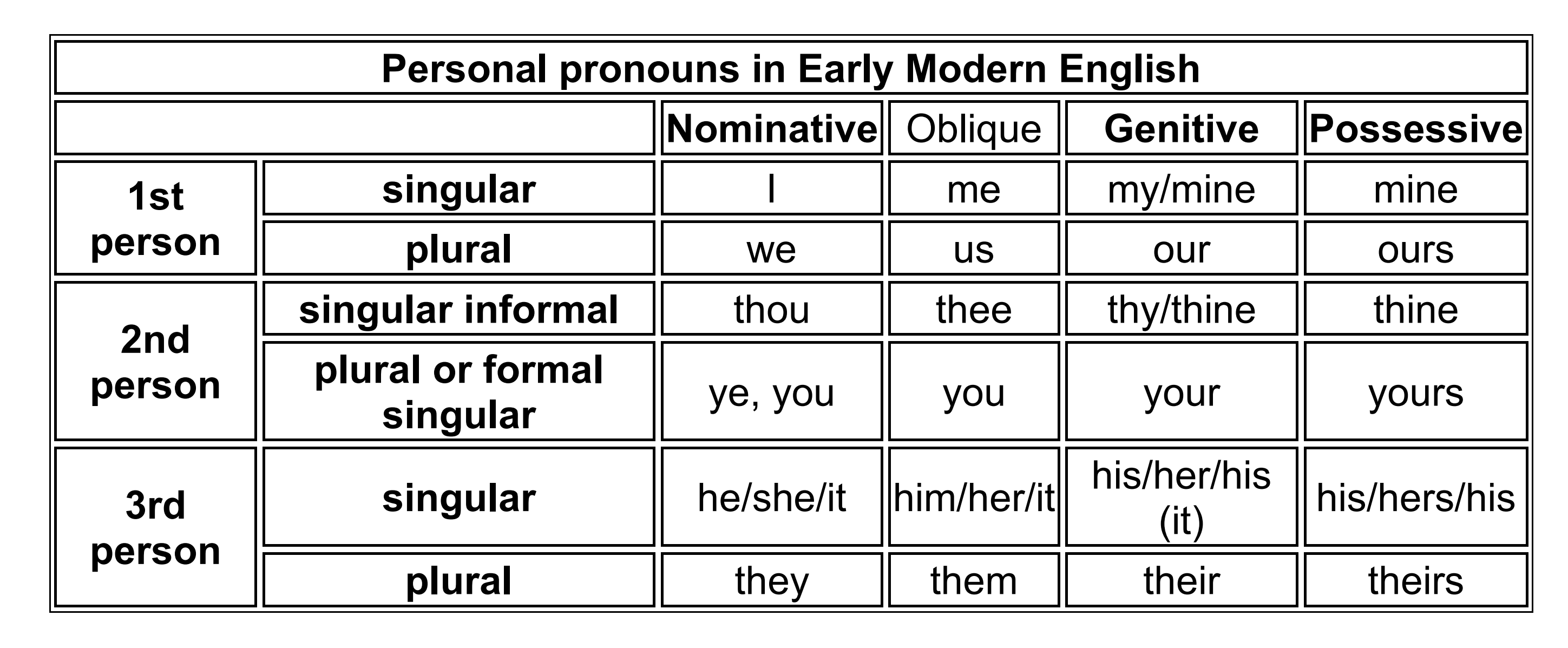
The study of Early Modern English extensively analyses the usage of genitives such as "my," "mine," "thy," and "thine." These forms serve as possessive adjectives before nouns and as possessive pronouns without a noun, but their usage varies depending on context.
The possessive adjectives "mine" and "thine" are used before nouns starting with a vowel sound or before nouns beginning with a silent letter "h." For instance, phrases like "thine eyes" and "mine heart" were pronounced as "mine art." Conversely, "my" and "thy" are employed before consonants, as seen in phrases like "thy mother" and "my love."
While all four forms can function as possessive adjectives, only "mine" and "thine" can stand alone as possessive pronouns without a noun, as in "it is thine" and "they were mine." It's essential to note that using "my" and "thy" as possessive pronouns without a noun is not grammatically correct, making phrases like "they were my" unacceptable.
A historical nuance related to the possessive pronoun "his" is worth mentioning. During the Early Modern English period until the 17th century, "his" was used as the possessive form for both the third-person neuter "it" and the third-person masculine pronoun "he." This usage can be observed in the King James Bible of 1611, where the phrase "groweth of it owne accord" illustrates the use of the genitive "it."
Regarding verb conjugation, when using the second-person singular pronoun "thou," verb forms typically end in "-est" or "-st" in both present and past tenses in the indicative mood, applying to both strong and weak verbs. It's important to note that the inclusion of the letter "e" in the ending was not standardized in Early Modern English spelling and often depended on metrical considerations in verse.
In essence, delving into Early Modern English uncovers the intricacies and changes in grammar and usage throughout this historical epoch. The examination of genitives and verb conjugations offers valuable insights into the linguistic customs and norms that held sway during this era.
* to know: thou knowest, thou knewest
* to drive: thou drivest, thou drovest
* to make: thou makest, thou madest
* to love: thou lovest, thou lovedst
* to want: thou wantest
Modal verbs also have -(e)st added to their forms:
* can: thou canst
* could: thou couldst o may: thou mayest
* might: thou mightst
* should: thou shouldst
* would: thou wouldst
* ought to: thou oughtest to
A few verbs have irregular thou forms:
* to be: thou art (or thou beest), thou wast (or thou wert; originally thou were)
* to have: thou hast, thou hadst
* to do: thou dost (or thou doest in non-auxiliary use) and thou didst
* shall: thou shalt
* will: thou wilt
A few others are not inflected:
* must: thou must
In Proto-English, the verb inflection for the second-person singular was -es. This form remained unchanged from its Indo-European roots and is evident in Indo-European languages that are quite distantly related, such as Russian (znayesh), meaning "thou knowest," and Latin amas, meaning "thou lovest." (This mirrors the historical development of the third-person form, which in Old English was -eþ, seen in Russian (znayet), meaning "he knoweth," and Latin amat, meaning "he loveth.") The anomalous shift from -es to the modern English -est occurred independently at around the same time in closely related German and West Frisian languages. This shift is understood to be caused by the assimilation of the consonant of the pronoun, which often followed the verb. This phenomenon is most evident in German: liebes du >> liebstu >> liebst du (lovest thou).
Acknowledgements
It is interesting to note that translations of these ancient text were mostly done in 17th and 18th century. I have relied mostly on translations and research by Georg Long, a classical scholar; see short biography below.
Although I used Gataker, Hays, Gill, Zimmern, Haines, Casaubon, Hard, Theiler (in German) and others. I found some of them quite chatty and a little vulgar; and not as scholarly as I hoped. It is always difficult to deal with anachronism; some have, in my view, succeeded better than others. I relied on the translations of George Long, for this is, in my view, the most scholarly work is reflecting the spirit of the times.
Marcus was a philosopher with the most excellent education and elegance of thought (although his Koine Greek was not known for its elegance, I am told). Some translators have not appreciated that fact and, together with the difficulty anachronism posed, it may have reflected itself in their translations.
To my understanding, the simplicity of his communication "to his own self" is set in a simple and personal language. For this reason I retained personal pronouns in second person singular as thou, thee and thine. I felt that the generality of modern pronouns in second person plural was not used in his time and in the context of his communication and all other communication, for that matter. Thus, I thought that my substituting "second person singular" pronouns with plural and modernising the text would have taken away the tone and the spirit of his communication.
About George Long, the Translator
Long was born at Poulton-le-Fylde, Lancashire, the son of James Long, West India merchant. He was educated at Macclesfield Grammar School, St John's College, Cambridge and later Trinity College, Cambridge.He was Craven university scholar in 1821 (bracketed with Lord Macaulay and Henry Maiden), wrangler and senior chancellor's medallist in 1822 and became a fellow of Trinity in 1823. In 1824 he was elected professor of ancient languages in the new University of Virginia at Charlottesville, but after four years returned to England as the first professor of Greek at the newly founded University College in London.
In 1842 he succeeded T. H. Key as Professor of Latin at University College; in 1846-1849 he was reader in jurisprudence and civil law in the Middle Temple, and finally (1849-1871) classical lecturer at Brighton College. Subsequently, he lived in retirement at Portfield, Chichester, in receipt (from 1873) of a Civil List pension of £100 a year obtained for him by Gladstone.
He edited the quarterly Journal of Education (1831-1835) as well as many of its text-books; the editor (at first with Charles Knight, afterwards alone) of the Penny Cyclopaedia and of Knight's Political Dictionary; and a member of the Society for Central Education instituted in London in 1837.
He contributed the Roman law articles to Smith's Dictionary of Greek and Roman Antiquities, and wrote also for the companion dictionaries of Biography and Geography. He is remembered, however, mainly as the editor of the Bibliotheca Classica series-the first serious attempt to produce scholarly editions of classical texts with English commentaries- to which he contributed the edition of Cicero's orations (1851-1862).
Koine Greek Language
The Koine Greek Language, also known as "Common Greek," or the Alexandrian dialect, emerged as a blend of Attic and Ionic speech forms during the Hellenistic period. This linguistic fusion incorporated elements from various dialects, resulting in a versatile language ranging from formal literary styles to everyday vernaculars. As the primary language of the Byzantine Empire, Koine Greek continued to evolve, eventually giving rise to Medieval Greek and subsequently Modern Greek.
In the realm of literature, Koine Greek played a pivotal role, being utilized by renowned authors such as Plutarch and Polybius. Its significance extended to religious contexts as well, serving as the language of the Christian New Testament, the Septuagint (the Greek translation of the Hebrew Bible), and early Christian theological writings. Within religious circles, it is alternatively known as "Biblical," "New Testament," "ecclesiastical," or "patristic" Greek.
Roman Emperor Marcus Aurelius contributed to this literary tradition with his personal reflections. Furthermore, Koine Greek remains integral to the liturgical practices of the Greek Orthodox Church.
In summary, Koine Greek emerged as the lingua franca during the Hellenistic period, shaping the linguistic landscape of the Roman and early Byzantine Empires. Its influence transcended regional boundaries, permeating various aspects of literature, religion, and scholarship. The enduring legacy of Koine Greek endures through ancient texts and its continued use in religious rituals.